
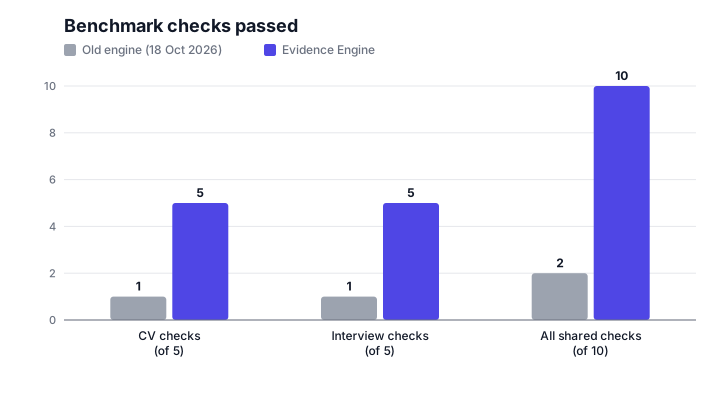
Direct answer: The Evidence Engine makes every AI claim about a candidate checkable. A requirement only counts as met when the review quotes words that really appear in the CV or the interview. Interviewer speech can no longer count as candidate evidence, personal details are removed before the AI reads a CV, and the CV and the interview are reconciled by fixed rules a person can follow. On our benchmark the old engine passed 2 of 10 checks; the Evidence Engine passes all of them.
What changed
Kadroflow has always treated its AI review as a review aid, not a decision. A recruiter reads it, checks it and decides. That only works if every line can be checked: which sentence in the CV supports this requirement, and what did the candidate actually say in the interview?
So we rebuilt the engine behind the review. The changes, in brief:
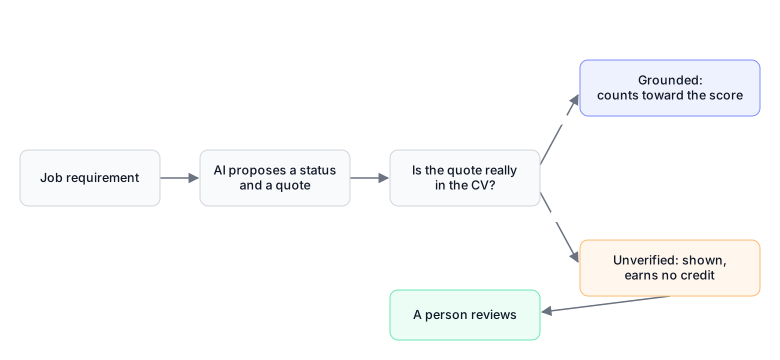
- Every claim quotes the candidate. A requirement counts as met only when the review cites words that appear in the CV or the transcript. A paraphrase the AI made up earns no credit.
- The interviewer's words are not the candidate's. The transcript is split by speaker, and only the candidate's turns can be quoted as evidence.
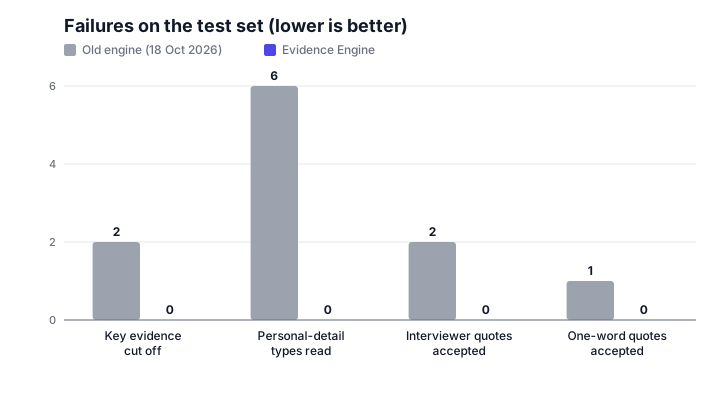
- Personal details never reach the AI. Lines with a birth year, nationality, gender, marital or family status, religion or a photo are removed from the CV before analysis. They are removed outright, not swapped for a placeholder.
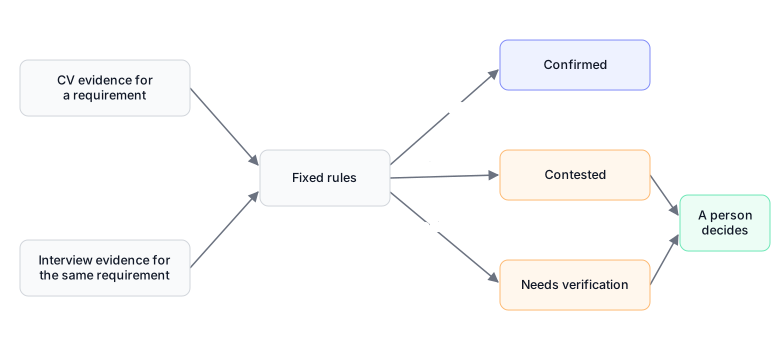
- The CV and the interview are reconciled by fixed rules, not by another AI. Agreement is confirmed; disagreement is marked as contested; only a person can mark a requirement as missing.
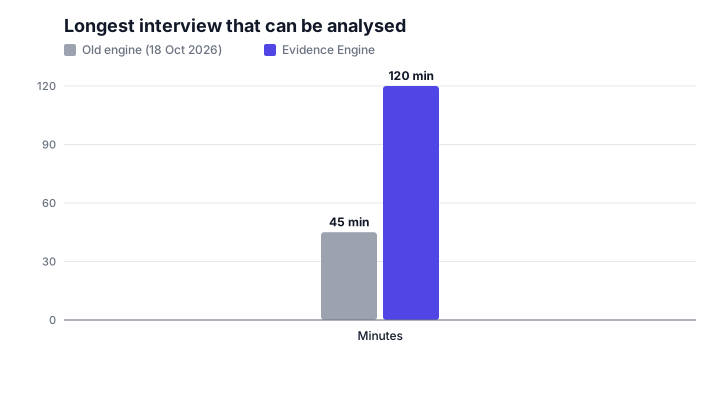
- Longer interviews. Recordings of up to 120 minutes can be analysed, up from 45.
How we measured it
We built the measurement before changing any code. We wrote a synthetic test set of eight CVs and three interviews for fictional candidates in frontend engineering, payroll and warehouse roles, and labelled each requirement with the right answer and the exact words that prove it. No real candidate's data is in the set.
The set contains deliberate traps: a CV carrying protected personal details, a CV with a hidden instruction aimed at the AI, a long CV whose key evidence sits near the end, an interview where the interviewer says the impressive sentence, and a one-word “Yes” answer.
Each weakness became an automated check that runs on every build. A check that still fails is recorded as a known gap. When a fix makes it pass, it is locked in, and any later change that breaks it again fails the build.
The benchmark: old engine against the Evidence Engine
We ran the same checks against the engine as it was when the work began (18 October 2026) and against the engine today. The checks are deterministic: no AI call and no randomness, so anyone running them gets the same answer. Ten checks exist in both versions; three more were added along the way and all pass, so today 13 of 13 pass with no known gaps.
Every claim has to quote its source
The old engine asked the AI for a verdict per requirement and largely trusted it. The new engine asks for a verdict and the exact words that support it, then checks those words against the source.
An unverified claim is not turned into “missing”. A paraphrase is not proof the candidate lacks the skill; it is a question for the recruiter, and only a person can mark a requirement as missing.
Interviews: who said what
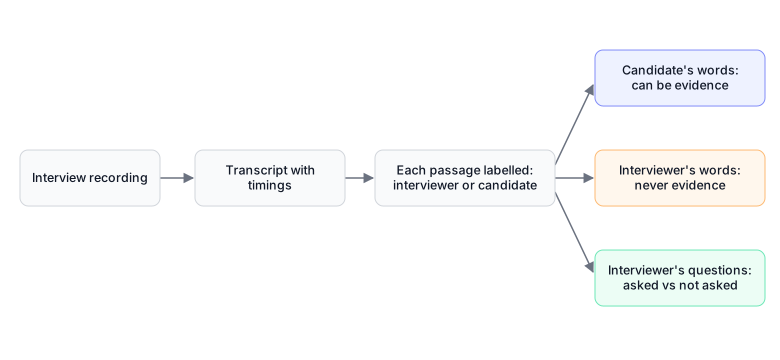
A transcript is a conversation, and the old engine read it as one block of text. If the interviewer said “everything we ship is strict TypeScript”, that sentence could come back as evidence that the candidate knows TypeScript.
Speaker roles are worked out from what was said, never from voice characteristics, and a person can confirm or correct them. Because the interviewer's questions are known, the review can tell “not asked” apart from “asked, but no evidence”. Each quote also links to the moment it was said.
A panelist sees the AI's interview evidence only after submitting their own scorecard, so the AI cannot anchor the people whose judgement it supports.
Reconciling the CV and the interview
After an interview, the CV view and the interview view of each requirement are combined by fixed rules with no AI involved, so the same evidence always gives the same result. If the recalculation cannot reproduce the published score from the same inputs, it declines rather than guesses, and a person's decision is never overwritten.
An optional check can flag a possible contradiction between the CV and the interview, such as five years of a skill on the CV and about two in the interview. It is off by default, and when switched on it only adds a flag for a person to read. It never changes a status, a weight or a score.
What the numbers are not
These checks prove the engine behaves correctly on cases where we know the right answer. They are not an accuracy score, and they are not a claim about fairness or legal compliance.
Accuracy needs real AI runs compared with human labels. We measure it separately as agreement between the AI and the labels, and between the AI and each interview panel. Inside the product, panel-versus-AI agreement per competency appears only once there are at least ten pairs to compare. We will publish accuracy figures when there is enough data to stand behind them.
Use the worksheet with your team
No form or account required. Adapt the template to the role and review it before use.
Download the benchmark method and results (Markdown)What you can verify in Kadroflow
In Kadroflow every requirement on a candidate's assessment shows the quote behind it and says when a claim is unverified. Open, Contested and All filters lead to the requirements that need a person, and interview evidence links to the moment in the recording. None of this changes who decides: the Evidence Engine makes the AI's work easier to check, not the decision-maker.
Frequently asked questions
Does the Evidence Engine decide which candidates move forward?
No. It is a review aid. Every stage change is a person's decision, and only a person can mark a requirement as missing.
Was real candidate data used to test it?
No. The test set is written for testing and contains fictional candidates only. No real CV or interview is used.
Is the benchmark an accuracy score?
No. It checks behaviour on cases with a known right answer. Accuracy is measured separately against human labels and will be published when there is enough data.
Sources and further reading
About this guide
Kadroflow publishes practical guidance about recruiting operations, structured evidence and accountable human decisions in AI-assisted hiring.
Examples are illustrative. For editorial corrections, contact support@kadroflow.com.
Continue reading
- Why hiring context breaks — and how one candidate record repairs it
- Human-controlled AI in recruitment: a practical review checklist
- Candidate communication workflow: owners, updates and email templates
- Structured interview scorecard: a template and worked example
- How to modernize an HR department: a practical 90-day roadmap
- HR reporting system: what to measure, automate and review
- ATS implementation checklist for EU HR teams
Compare Kadroflow plans or explore the product to check whether the workflow fits your team.